
Before you sign: understanding an NDIS service agreement
Before you agree to a new support service, you should understand the services you’ll receive, what it will cost and what happens if your arrangements change. A service agreement puts those details in one place.
For NDIS participants, it is worth checking the agreement against both your needs and your available funding. Here is what to look for before signing
What are you agreeing to?
A service agreement records the arrangement between you and your provider. It explains the supports they will deliver, the costs, each party’s responsibilities and how changes or problems will be handled.
The National Disability Insurance Agency (NDIA) recommends written agreements for most supports. Some services have additional requirements: written agreements are mandatory for Specialist Disability Accommodation (SDA), and Supported Independent Living (SIL) has specific agreement standards. Ask which requirements apply to your service.
An agreement can create obligations for you as well as the provider. Take time to read it, ask questions and suggest changes before you agree. Australian Consumer Law also applies when you buy NDIS supports from a business.
Make sure the support is clearly described
Broad wording such as “ongoing support” leaves too much unclear. Ask the provider to describe what the service will involve in practice.
What tasks or activities will the provider support you with?
How often will support happen, and for how long?
Where will it happen, and will it be individual or shared support?
What happens if your usual worker or practitioner is unavailable?
Check that the written details match your discussions. If you agreed to fortnightly appointments, the agreement should reflect that. Registered providers covered by the core NDIS Practice Standards must work with participants to establish clear expectations about their supports.
Understand the full cost
The hourly rate may be only part of the bill. Ask about provider travel, reports, work completed outside appointments, materials and any other proposed charges. Request an estimate of the total cost over the agreement’s duration.
The current NDIS pricing schedules set maximum prices for NDIA-managed and plan-managed supports. A maximum price is a ceiling, rather than a price you must automatically accept. Ask what rate the provider proposes and whether you can negotiate it.
Also check how price changes will be communicated and whether the agreement automatically adopts future pricing updates. You should understand the financial commitment before support begins.
Check your funding before committing
October 2026 brings a reason to review some agreements. The NDIA confirms budget reductions in Social, Economic and Community Participation and Improved Daily Living Skills as plans are created or reassessed from 1 October 2026, or renewed from 1 February 2027. Some supports are excluded, and the impact differs between participants. This does not mean everyone’s whole plan was reduced on 1 October.
When checking an agreement, separate these four things:
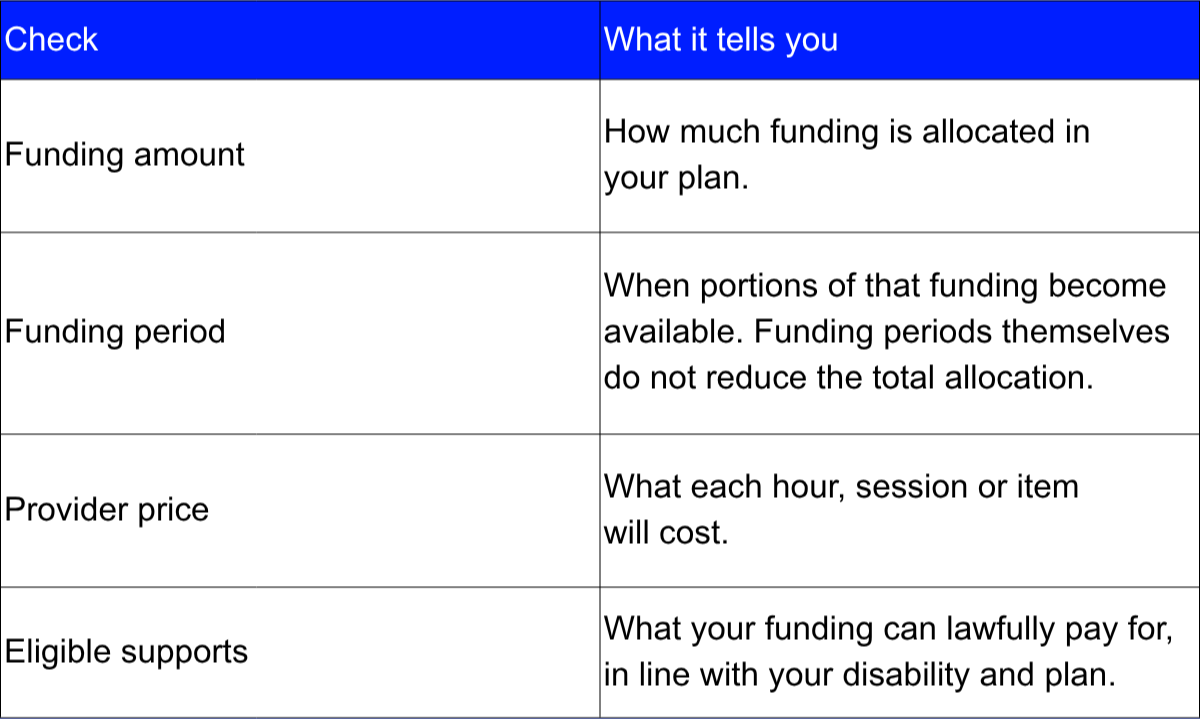
These are different checks. A support appearing in an agreement does not, by itself, make it an eligible NDIS expense.
Our guide to understanding your NDIS plan explains the main funding categories.
Compare the proposed schedule with your current plan, available funding and commitments to other providers. Ask your plan manager about payments and available balances, if you have one. Ask your my NDIS contact to clarify whether a funding change applies to you.
Read the cancellation and exit terms
Cancelling one appointment and ending the whole agreement are different things. Check the notice required for each, how notice must be given and what charges may follow. Ask what happens if you are unwell or the provider cancels.
For any proposed cancellation charge, ask the provider to identify the claiming rules that apply to your particular support. Avoid assuming one notice period applies to every service.
If you want to change providers, read the exit terms and plan the handover. Where the core Practice Standards apply, providers must facilitate a planned, coordinated transition with the participant where possible.
You can ask for changes and support
A provider’s template can be discussed. You can ask for wording to be explained or changed, and for information in a language or communication format you understand. You can involve a trusted person, support coordinator or recovery coach if you choose.
Keep a copy of the final agreement and any agreed changes. For concerns about the safety or quality of NDIS services, you can contact the NDIS Quality and Safeguards Commission on 1800 035 544. Questions about your plan’s funding belong with the NDIA.
Before signing, mark anything you cannot explain in your own words and ask the provider to talk it through.
At Newcastle Social Workers, our qualified local professionals help you understand your plan, find suitable providers and manage your supports. If you would like support to work through an agreement, get in touch.
